AI for COOs
Who Owns an AI-Assisted Handoff When the Input Is Incomplete?
SimplSolutions Editorial Team · 7 min read
Published

The operational problem is ownership, not just missing data
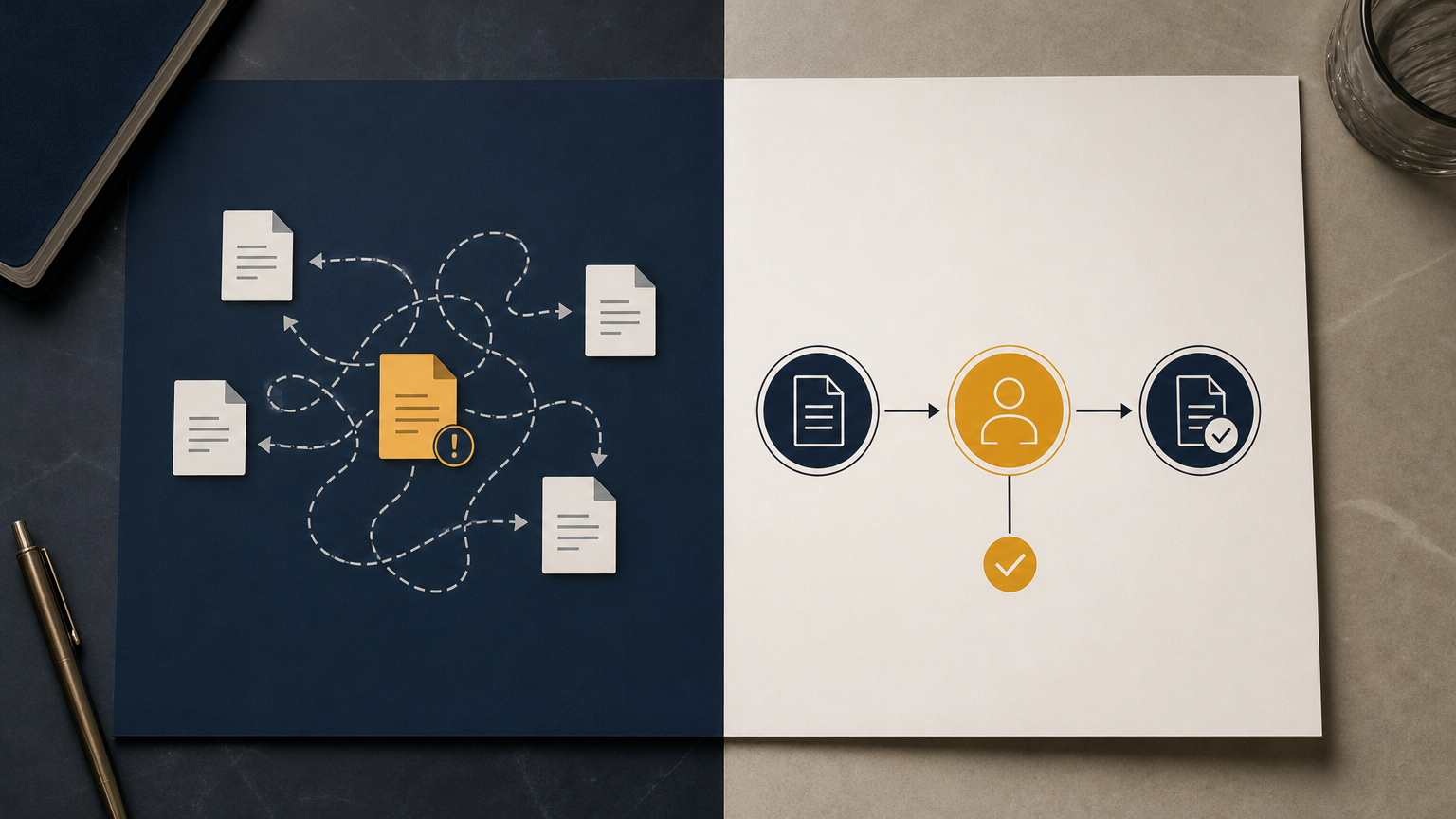
An AI-assisted handoff can look complete while still lacking information needed for the next team to act safely. A service request may include a clear description but omit authorization, site details, access constraints, customer impact, or a required delivery window.
The common response is to ask the AI to infer the missing information or send the item onward with a note. Neither approach answers the COO’s central question: who owns the decision to stop, complete, or release the handoff?
If ownership is unclear, the gap becomes someone else’s problem. The receiving team may chase the requester, make an assumption, or begin work that later has to be reversed. The result is not merely a data-quality issue. It is an accountability failure at the boundary between teams.
What responsible AI guidance does—and does not—settle
The NIST AI Risk Management Framework is intended for voluntary use and is designed to help organizations manage risks associated with artificial intelligence. NIST says the framework is intended to improve the ability to incorporate trustworthiness considerations into the design, development, use, and evaluation of AI systems.
That is useful context for an operating model, but it does not assign a specific owner for an incomplete service request. A framework can inform governance; the business still has to define who makes the operational decision.
For COOs, the practical translation is straightforward: do not treat “human oversight” as a general aspiration. Attach it to a role, a decision, a record, and a time-bound escalation.
A five-part ownership framework
1. Name the responsible human
Assign one accountable operations role for the handoff stage. This does not necessarily mean the person who originally submitted the request or the person who will ultimately fulfill it.
The responsible owner should be able to:
- see what information is missing;
- request completion from the right source;
- decide whether an approved exception is acceptable;
- stop downstream work when the risk is material; and
- approve release when the minimum information is present.
Avoid assigning accountability to “the team,” “the queue,” or “the AI workflow.” Those labels may describe where work is visible, but they do not identify who can make the decision.
2. Define the minimum required fields
A handoff does not need every possible field before it can move. It does need the fields that protect the next decision.
For a service request moving from intake to fulfillment, the minimum set might include:
- a specific service or outcome requested;
- an authorized requester or approver;
- the location or asset affected;
- the required timing or service window; and
- constraints that could change safety, access, cost, or customer impact.
The exact fields should be set by the business process, not by the AI. The useful test is: what would the receiving team have to know before acting without making a consequential assumption?
Classify missing information by consequence. A missing preference may permit the work to wait in a normal queue. Missing authorization or site access information may require a hard stop.
3. Create an explicit exception queue
An incomplete handoff should become a visible operational state, not an informal comment buried in a record.
The exception should identify:
- the handoff owner;
- the missing field or unresolved conflict;
- the source expected to provide it;
- the downstream action currently blocked;
- the time the exception entered the queue; and
- the next escalation point.
AI can help detect and summarize these gaps. It should not silently convert uncertainty into completion. A clear exception state also lets leaders distinguish a genuine demand problem from a process-quality problem.
4. Set a service-level trigger
A queue without a time boundary becomes a parking lot. Set a service-level trigger for unresolved exceptions based on the consequence of delay.
For example, a low-impact request might trigger a reminder after one business day. A request tied to a customer commitment, safety concern, or scheduled field visit may require faster escalation.
The trigger should answer three questions:
- When does the owner receive a reminder?
- When does the issue move to a backup owner or manager?
- When must the business notify the requester or revise the expected outcome?
These are operating decisions, not AI settings. They should be reviewed with the teams that absorb the delay and the teams that provide the missing information.
5. Draw the approval boundary
The AI may prepare a handoff, extract details, identify a likely missing field, and route the exception. A human should retain approval for actions where an incorrect assumption could create material operational, financial, safety, privacy, contractual, or customer consequences.
The approval record should make clear:
- what information was available;
- what was missing or uncertain;
- whether the gap was resolved or accepted as an exception;
- who approved the next step; and
- when the approval occurred.
This is not a requirement that a person manually retype everything the AI prepared. It is a requirement that the responsible person can understand the decision and own it.
Worked example: a service request with missing authorization and site details
Imagine a service request that arrives through an existing intake channel. An AI assistant summarizes the request and prepares a handoff for fulfillment. It identifies two gaps: the requester’s authorization is not confirmed, and the affected site is not specified.
A responsible operating model would treat those gaps differently from a missing descriptive detail:
- Detection: The AI flags the missing authorization and site details rather than presenting the handoff as ready.
- Ownership: The item is assigned to a named operations owner for the intake-to-fulfillment stage.
- Blocking decision: The owner keeps fulfillment blocked because the team cannot confirm permission or location.
- Completion path: The exception identifies the requester or business contact expected to supply each missing field.
- Escalation: If the information is not supplied within the defined service-level window, the item moves to the designated backup owner or manager.
- Release: Once the required information is confirmed, the human owner approves the handoff and the record preserves that decision.
The existing ticketing, service, or work-management system can remain the system of record. The important change is the clarity of state and ownership around the handoff.
What the AI should prepare—and what it should not decide
A useful division of responsibility is:
AI-assisted preparation
- identify likely omissions or contradictions;
- summarize the request for the next team;
- point to the source of available information;
- suggest the appropriate exception category; and
- route the item to the designated owner.
Human accountability
- determine whether the minimum fields are actually sufficient;
- resolve ambiguity that could change the outcome;
- approve an explicitly permitted exception;
- stop or release downstream work; and
- accept responsibility for the operational decision.
This boundary avoids two opposite mistakes. The first is over-trusting an AI-generated completion. The second is forcing humans to perform every clerical step that an assistant can safely prepare.
Questions a COO should ask before expanding the workflow
Before introducing AI into another handoff, ask:
- Which role is accountable when the handoff is incomplete?
- What information is truly required before the next action?
- Which missing fields create a hard stop, and which allow a controlled exception?
- Where will unresolved items be visible?
- What happens when the named owner is unavailable?
- How quickly must the exception be addressed?
- Which actions require explicit human approval?
- Can a reviewer see what the AI detected, what the human changed, and why the item proceeded?
- Which existing system remains authoritative for the work record?
If the answers are vague, adding AI may increase the speed of ambiguity rather than improve the handoff.
What remains uncertain
No universal minimum field set works across industries or processes. The right threshold depends on the consequences of acting with incomplete information, the authority of the requester, and the reversibility of the downstream action.
NIST’s framework provides a voluntary risk-management reference point, not a substitute for process-specific accountability. Organizations should also confirm how their legal, regulatory, contractual, privacy, safety, and information-governance obligations apply to each workflow.
The responsible operating principle is therefore narrow and durable: let AI help identify and route uncertainty, but make the business owner explicit about whether work can proceed.
A practical next step
Choose one high-volume handoff that regularly returns for clarification. Map its minimum required fields, name the accountable owner, define the exception queue, set one escalation trigger, and document the approval boundary. Review a sample of real handoffs with the teams on both sides of the boundary before expanding the pattern.